
Concrete Crack Depth Testing Services: Understanding Cracks Before Planning Repairs
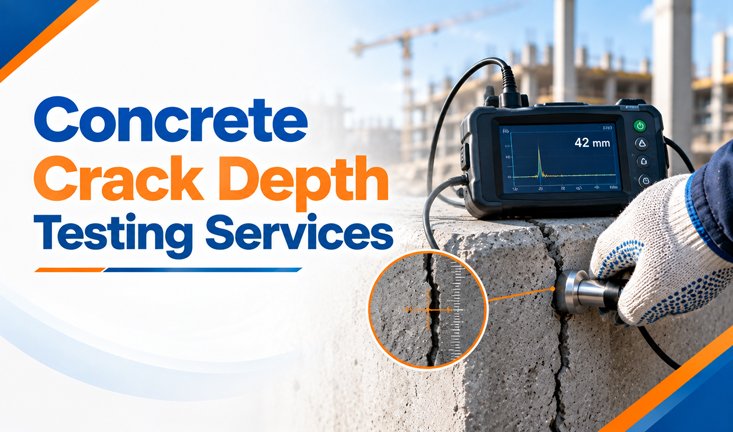
Cracks in concrete are common, but they should not all be treated in the same way.
Some cracks develop because of shrinkage or temperature changes, while others may be associated with settlement, loading, reinforcement corrosion or structural movement.
Professional Concrete Crack Depth Testing Services help engineers investigate cracks and collect information needed for further structural assessment.
Why Crack Depth Matters
The visible width of a crack does not necessarily indicate how far it extends into a concrete member.
A narrow surface crack may be relatively shallow, while another crack may extend deeper into a slab, beam or structural wall.
Understanding crack depth helps engineers investigate the condition more thoroughly.
Crack measurements may support decisions about repair methods, continued monitoring and additional structural testing.
Common Causes of Concrete Cracks
Concrete cracking can result from several conditions.
Drying Shrinkage
Concrete may contract as moisture is lost, creating tensile stresses that can lead to cracking.
Temperature Changes
Expansion and contraction caused by temperature variations may produce cracks when movement is restrained.
Structural Loading
Excessive or unexpected loading can contribute to cracking in structural members.
Foundation Settlement
Uneven settlement may create stresses within concrete structures.
Reinforcement Corrosion
Corroding reinforcement can expand and contribute to cracking and spalling of surrounding concrete.
How Is Crack Depth Investigated?
Different techniques may be used according to the crack location, concrete characteristics and required measurement.
Ultrasonic methods can help investigate crack depth under suitable conditions.
Engineers may also use Gpr Testing Services where radar-based structural investigation is appropriate.
For wider structural assessments, Concrete Ndt Services may combine multiple testing techniques.
Why Proper Investigation Is Important
Repairing a crack without understanding its cause may not address the underlying problem.
A suitable investigation considers crack dimensions, location, possible movement and structural significance.
Engineers may recommend monitoring, additional testing or repair depending on the findings.
Conclusion
Concrete crack depth testing provides useful information for structural condition assessment.
Understanding the extent and possible causes of cracking helps engineers plan appropriate maintenance and repair strategies.